
Solid, Filled, Plated or Vermeil? How to Read Gold Jewelry Before You Buy or Sell
November 23, 2026 · Lumo.gold
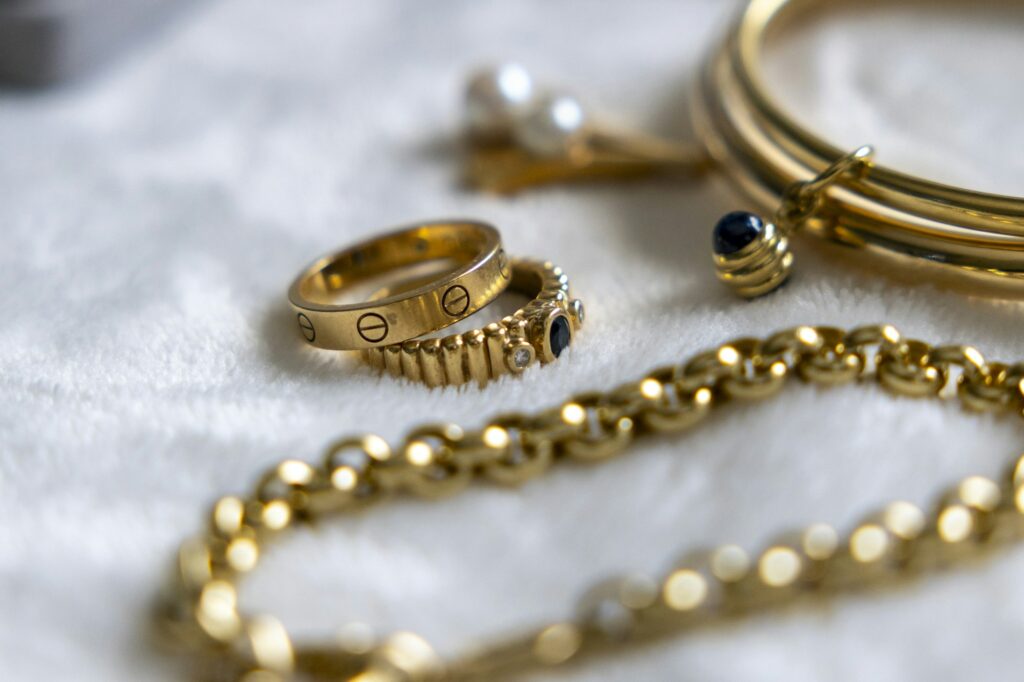
Two necklaces can look identical under store lights and differ in gold content by a factor of twenty or more. One is solid 14-karat gold all the way through. The other is a base metal wearing a coat of gold thinner than a human hair. Both may be described as “gold” in casual conversation, but the federal guides that govern jewelry marketing treat them very differently, and so does every buyer who will ever make you an offer.
Whether you are shopping for holiday gifts or sorting a drawer before selling, learning the vocabulary of gold surfaces is one of the most valuable things you can do. Here is what the terms mean, according to the Federal Trade Commission’s Guides for the Jewelry, Precious Metals, and Pewter Industries (16 CFR Part 23), and what each means for value.
The word “gold” by itself
Under the FTC guides, using the word “gold” without qualification is treated as potentially misleading unless the item is made throughout of 24-karat gold. A gold alloy should carry a correct karat designation right before the word, as in “14 K. Gold” or “14 Kt. Gold,” and a solid alloy piece may simply be marked “14K” or “14 Karat.”
The guides also tie markings to accuracy. Under the National Stamping Act tolerances cited in the guides, a gold article without solder may vary from its marked fineness by only 3 parts per thousand, and 7 parts per thousand when the tested portion includes solder.
A related disclosure many shoppers miss: the guides say a hollow-center gold alloy product should disclose that it is hollow next to the word “gold.” Hollow pieces look substantial but weigh far less, which matters when value is based on weight.
The coated categories, from thickest layer to thinnest
Gold filled
“Gold filled” sits at the top of the coated categories. According to 16 CFR 23.3, the term describes a product with a layer of gold alloy of at least 10 karat mechanically applied to a base metal, where the gold alloy makes up at least 1/20th of the weight of the metal in the entire article.
Gold-filled pieces can wear well for years, but they are not solid gold. Because the gold is at most a small fraction of the weight, buyers who purchase scrap may offer little or nothing for them, or decline them entirely.
Rolled gold plate and gold overlay
“Rolled gold plate” (often marked R.G.P.) and “gold overlay” describe the same mechanical bonding process with a thinner layer. Under 16 CFR 23.3, the gold alloy must be at least 10 karat and make up at least 1/40th of the metal weight, and the guides call for marking the fraction and karat, for example “1/40 12 Kt. R.G.P.” Old watch cases and vintage costume pieces frequently carry marks like this.
Gold plate, gold electroplate and heavy gold electroplate
Plating is a different process, and the layers are thinner still. The FTC guides describe:
- Gold plate: a plating of gold alloy of at least 10 karat, applied by any process, thick enough to give “reasonable durability.”
- Gold electroplate: an electrolytically applied coating of at least 10 karat with a minimum thickness of 0.175 microns of fine gold, about 7 millionths of an inch. The guides give “12K G.E.P.” as an example mark.
- Heavy gold electroplate: the same process with a minimum thickness of 2.5 microns of fine gold, about 100 millionths of an inch.
The guides also address layered products: if a gold-plated or gold-filled layer is covered by a base metal such as nickel and then a thin gold wash, the seller should disclose that layering.
For sellers, the practical takeaway is blunt. Electroplated items contain so little gold that their value is almost entirely in their usefulness or style, not their metal.
Vermeil
Vermeil (pronounced “ver-MAY”) is the one coated category built on a precious base. Under 16 CFR 23.4, an item may be called vermeil if it is sterling silver coated or plated on all significant surfaces with gold or gold alloy of at least 10 karat, with a gold layer at least 2.5 microns thick. The guides add that sterling first covered with a base metal such as nickel, then gold-plated, should not be called vermeil without disclosing that layer.
Vermeil’s value usually tracks its silver content more than its gold. Under 16 CFR 23.5, “sterling” requires at least 925 parts per thousand pure silver.
A quick reference: what you are really holding
- 10K / 14K / 18K / 22K or 417 / 585 / 750 / 916: solid gold alloy. Value is weight times purity.
- GF or “gold filled” with a fraction such as 1/20: gold alloy is a small share of total weight.
- R.G.P. or “gold overlay,” often with 1/40: thinner bonded layer.
- G.E.P., “gold electroplate” or “HGE”: microns-thin coating; minimal gold.
- “Vermeil” or “925” with gold color: sterling silver with a gold layer.
- No mark at all: unknown until tested. Do not assume solid or plated.
Buying this season: questions to ask at the counter
Holiday displays mix solid, filled, plated and vermeil pieces side by side. Before you pay:
- “Is this solid karat gold, or is it filled, plated or vermeil?” Ask for the answer in writing on the receipt.
- “What is the karat, and where is the mark?” Look at it yourself.
- “Is it hollow?” The FTC guides call for that disclosure, and it changes the weight you are paying for.
- “What is the return policy?” The FTC’s jewelry shopping advice recommends knowing the refund and return policy before you buy.
None of these coated categories is a bad purchase. A well-made vermeil or gold-filled piece can be lovely and durable at a fraction of the price of solid gold. The problem is only paying a solid-gold price for something that is not.
Selling: set expectations before you go
When you clean out a jewelry box before a sale, set filled, plated and vermeil items in their own pile. AARP’s selling guide notes that silver-plated items usually have no scrap value, and the same logic applies to thin gold coatings. Some buyers will purchase gold-filled items in bulk at a low rate; many will not. Vermeil may be bought for its sterling content.
Ask each buyer up front which categories they purchase. A trustworthy buyer will tell you plainly that a plated chain is worth more as jewelry than as metal, rather than quietly folding it into a bag.
Can a stamp be wrong?
A mark is a strong clue, not a guarantee. Stamps can be worn away, added by a previous repair, or simply false. That is why buyers test. AARP reports that buyers verify purity using stamps, electronic testers or acid testing. Surface tests have limits, though: NBC News reported that some counterfeit coins are base metal with a thin gold plating that can pass a simple acid test.
For sellers, the lesson is to let the buyer test and to watch how they do it. For buyers of expensive pieces, it is to purchase from established sellers who will put the karat and description on the receipt and stand behind it. If a piece’s value really matters to you, a qualified appraiser can examine it more thoroughly than any quick counter test.
Bottom line
The color of a piece tells you almost nothing. The mark, the weight and the definition behind the mark tell you nearly everything. Learn the handful of terms above and you will read jewelry the way buyers do.
This article is general education, not financial advice; talk to a licensed professional (a tax advisor, attorney or financial planner) about your own situation. Lumo is an information site and directory that connects people with gold buyers and dealers; Lumo does not buy or sell gold.
Sources: 16 CFR 23.3, 16 CFR 23.4 and 16 CFR 23.5 (Cornell LII); FTC Consumer Advice; AARP
Quick check
How much did you catch? Tap a question to see the answer.
1. Under the FTC guides, what share of total metal weight must the gold alloy be in a ‘gold filled’ item?
Answer: At least 1/20th, with gold alloy of at least 10 karat.
2. What is vermeil made of?
Answer: Sterling silver coated with gold or gold alloy of at least 10 karat, at least 2.5 microns thick.
3. Why does a hollow-center disclosure matter?
Answer: Gold value is based on weight, and hollow pieces weigh much less than they look.